06 October 2005

We’re Going Home


“Safe... when I'm with you I feel so safe... like I'm home.” - Andrew Largeman in Garden State

Home is most definitely not a place. It’s a feeling. I think this quote from the film “Garden State” sums up most of what I think about home. For me being home is feeling safe and comfortable.

Home is often a group of people. This includes my family, of course, but also a small group of friends. Whether at one of their houses, in a car, or bumming around at Waterfront Park I feel like I’m at home. This has to do with the level of comfort. Being at home with someone means you can trust them, and they can trust you.

In looser terms home could be any place. In Ways of Knowing we’ve been talking a lot about feeling at home in nature, in the world, and finding home in your own mind. This is just as important as being at home with people. In nature you can feel like you belong there, just like the feeling of belonging with friends and family.

I’m going back home for Thanksgiving. I don’t know what I’ll feel like. I hope I still feel like I belong there. I think I am lucky because my room hasn’t been taken over by my brother, like a few other people. (Although he did threaten to knock out the wall separating our rooms and make it a “man-lounge,” (his words not mine) complete with dark wallpaper and leather chairs.) I look forward to seeing my family, my cats, and my friends. It will be like home again to go to the Christmas tree lighting the day after Thanksgiving for our annual tradition, although it will be a bigger group now that everyone has a date to bring with them. I am glad that our group is flexible like that; we can make our circle of home bigger.

I know there will be a time when my house doesn’t feel like home anymore. It might be when I stop coming home for every school break, when I move out for good, when I get married, or buy my own house. Although I know that will be a hard experience I’m glad that I know that I will always be home with the people I love.

More Garden State:
Andrew: You know that point in your life when you realize that the house that you grew up in isn't really your home anymore? All of the sudden even though you have some place where you can put your stuff that idea of home is gone.
Sam: I still feel at home in my house.
Andrew: You'll see when you move out it just sort of happens one day one day and it's just gone. And you can never get it back. It's like you get homesick for a place that doesn't exist. I mean it's like this rite of passage, you know. You won't have this feeling again until you create a new idea of home for yourself, you know, for you kids, for the family you start, it's like a cycle or something. I miss the idea of it. Maybe that's all family really is: A group of people who miss the same imaginary place.


edit: so Noel and I used the same quote.... we are just awesome like that.

05 October 2005

On My Person

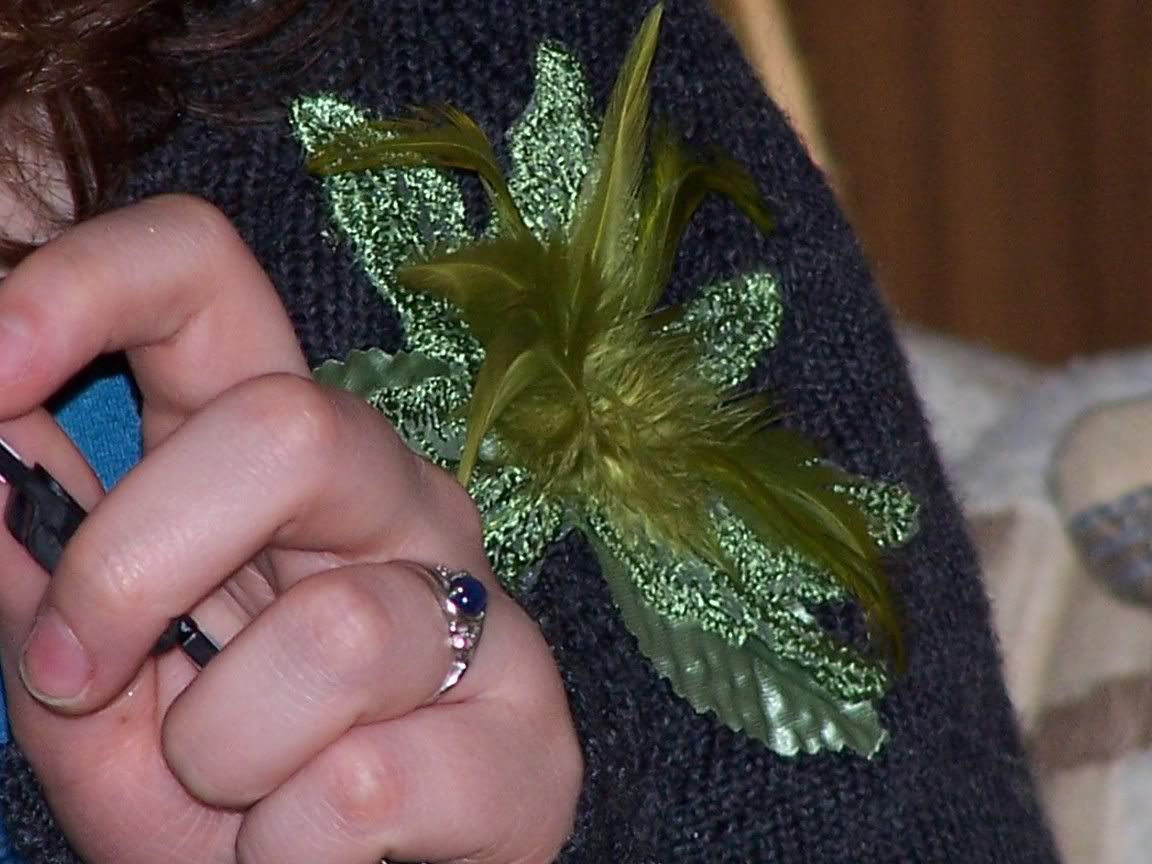
The jewelry I wear every day are some of the most important things I own. I wear my rings nearly every day. The most important one is white gold ring with a star sapphire in the middle with a tiny diamonds on either side that my mom gave me. I love the way the metal is shaped; swirling around each gem. Sometimes I stare at it in more boring classes (never comp…) and see if I can get the right angle to make the star appear in the blue stone. The second ring is my class ring. I think it’s cool because I designed it. It looks like a traditional class ring, but more feminine. It’s very personal; my birthstone is in it, and my name is engraved in the inside. The last ring I wear daily is a silver one I bought at the Saturday Market this summer at a little shop called Katmandu To You. Although it is newer than the other two the band is already bent from everyday wear. The band has a little dude that looks like a moon on it, which is also a circle. Attached to this is another circle which has a little swirl like an ‘s’. I don’t really know if it means anything. But I really like it.

I wear a bracelet everyday that I hardly ever take off. It looks like a silver ID bracelet but instead of a name it says “Peace.” This expresses a lot of things about me: I’m a peaceful person, generally, I support peace rather than war, and it reminds me to be at peace with my life. It is also sentimental as it is one of the first gifts Kellen gave me.

I have tons of other jewelry as anyone who has been in my room has seen. Most of them have little sentimental meaning, they are just pretty, and probably were really cheap. There are a few pieces that really mean a lot to me, these were the ones I choose to wear every day.

02 October 2005

my escapist dream


Here is my secret:

If time and money were no issue I would probably move to Crete.

Since I saw a show about Crete on the Travel channel a few years ago I have wanted to visit there. The biggest reason for this was the scenery. The turquoise Mediterranean Sea, the lush forests, and rocky canyons all looked too beautiful to believe.

I don’t know which region or what city I would live in, except it would have to be within walking distance of the beach, probably in a non-tourist area. I would become a local. I would live in a really small house. Bedroom, bathroom, cooking area is all I’d really need. Wealth isn’t my goal here; a simple and content life is what I would want in my Cretan bungalow.

I would want to work; I’d get bored just sitting around all day, even if I was surrounded by beauty. I might teach, or I might open a bike rental stand. Whatever I felt like. Someone would have to come with me in my move to Crete. I would get too lonely there by myself. I have actually talked to a few people about this and they seem to think it’s a great idea.

This wish is nearly impossible as I am too caught up in this country’s politics and trying to make it better and I don’t know how well moving away from it would help. There is always retirement.

01 October 2005

Nard

I thought it was really interesting how Knox became interested in the classics. His being involved in the wars made him look at the classic books in different ways than most people. This was especially noticeable when the author of the piece was talking about the questions of how much man has changed over the centuries. From the outside, the ancient wars and modern wars seem completely different. Perhaps with further studies you would see the similarities.

I think this assignment showed something important about writing. We were talking about leads in class, and this article proves that they are important. From what our class, and the author of the article said, no one was really drawn into the introductions for the Odyssey or the Iliad. Only upon finding out about the author are we drawn to actually read what he has to say. This seems to be the opposite of the workshop we did in class. I think that this article and the introduction itself prove that a great lead really can make a great piece of writing even better, and will cause more people to read it.

30 September 2005

the times they are a changin'


I may have watched “No Direction Home” on PBS too many times but so what.

To use my trip back in time I would go to the 1965 Newport Folk Festival. It would be amazing to see Joan Baez, Peter Paul and Mary, Pete Seeger, Odetta, and all of the other incredible artists there, but I have to admit I would be there for one person: Bob.

At his performance in the festival that year Bob Dylan revolutionized music. He changed the very idea of what a folk song could be. As he rolled into an electrified version of “Maggie’s Farm” many people in the audience and other performers saw it as a slap in the face to traditional folk music. They showed their displeasure by booing and jeering him, shouting at him to get rid of the electric guitar, or even to get rid of Dylan all together and bring back the act before him. Dylan continued to play two more electric songs, including one of his most famous, “Like a Rolling Stone”, and the crowd continued to boo. They were only silenced when reappeared with his acoustic guitar and harmonica and played “Mr. Tambourine Man” for the angry crowd.

Although his performance was short, it was enough to shake the music world. From that point on there was no turning back. Even the most die-hard folk purist had to admit that rock and roll was a legitimate art form and that Bob Dylan was the best person to prove it.

So, in short, if I went back in time I would cheer for Bob Dylan when he plugged in his electric guitar and changed music forever.

27 September 2005

I saw Paul McCartney play Live and Let Die live.

When I first thought about what my parents and I share I thought about music. But then I thought about it more and realized that it was mostly me playing the Beatles way too much and irritating my dad because I've only heard "I Wanna Hold Your Hand" 1,000 times and he's heard it 10,000 times. Just so you all know... My dad was "too cool to listen to The Beatles" in high school. But thankfully he likes their music today. My mom and I agree more, right down to our favorite Beatle, George. While I love music from my parent's (and grandparent's) generation we don't always agree on what the best is.

I didn't really want to write about music but I suppose it really is the thing that stands out most at least with my dad and me. The summer after my freshman year in high school my dad and I went to a Paul McCartney concert. At the time I was just really freaking excited to see Paul. Now I can look back on that though as not only a great concert but also a great experience with my dad. I have shared music with him too. I love the band the Barenaked Ladies. My dad has gone to two of their concerts with me. One of them I had asked a male friend to go to with me… and then my whole family came, but that’s another story. He now likes their music, and loves that they put on a great live show too.

I think that music is one of the easiest things that can transcend generations. The best reason I can think of for this is that a great band is just a great band. Even if a band’s look or music is a tad bit dated if the music is great people will continue listening to it for many years to come.

The thing that my mom has shared with me from her generation is…. clothes. My mom saved many of her clothes from college and from when she first started teaching. I love the look of many of them. In fact, I have stolen a few from her. Mostly blouses with ruffled collars and sleeves. My grandpa used to do leather tooling and made my mom belts, wallets, and key chains. I also have two belts that my mom once wore. On one the buckle broke and I haven’t been able to find one that will work with it. Needless to say, this is a tragedy. My mom thinks it’s hysterical that I love the clothes she has that she saw fade in and out of style.

It’s a lot harder to think of something that I have shared with my mom from my generation. I think the biggest thing is the freedoms that I experience that she didn’t. When my mom was in high school most of her female classmates aspired to be homemakers, teachers, or nurses. Although she technically could have done anything she wanted to, it was expected that she would do one of those things. Through having me as a daughter and watching me grow up I have been able to share with her the things that I can do that she could not. She always tells me how “things were so different when I was in college.”

Most of the things that connect me to my parents are the things from their pasts, literally. Over the years I have found remnants of my parents' youths; on shelves, in the basement, in trunks. These objects are many different kinds of things; pictures, boxes of records, clothing, yearbooks, photo albums, May Angels, newspaper clippings. I think I am fortunate that both of my parents are fairly sentimental and have kept so many of the objects from their pasts.

20 September 2005

George Harrison: Distinguished-Like

I never met George Harrison, but he taught me a lot of what I know about living. The lyrics to his songs are intelligent, moving, critical, loving. I’m not the type of person to be obsessed with a celebrity, and I hate the way this country idolizes them. There was just something about George that was sincere.

Since I picked out my first Beatles album (The Magical Mystery Tour) at Costco in fourth grade I have loved George Harrison. After studying his life a little more I realized that this man was more than just an amazing writer and a fabulous guitar player. This was a man who had figured out how to live life and be happy. What I figured out with some help from George was that much of being happy in life has to do with not being afraid of death. What is the point of being scared of something you can’t see, touch, or even know about without experiencing?

He knew that the important things in life are your family, your friends, the things you believe in, and your principles, not trends, not things that other people tell you are important. One of my favorite quotes from George is one that was printed in “Rolling Stone Magazine” after he died. “I’m not much of a career person,” he said, “I’m more of a gardener.” That said to me that he knew that his fame wasn’t that important in the long run of things. What was important is that he enjoyed living, he enjoyed his wife and son, he enjoyed working in his garden, and so that’s what he did. I cut this quote out of the magazine and taped it to my wall. I saw it everyday and it told me that I need to do what I love. Maybe I’d make the most money working in some cube, but if being a gardener makes me happy, that’s what I’ll do.

George saw the horrible hypocrisies in the world and hated them. Instead of just being angry he did something about it. One of the most notable was the Concert for Bangladesh. It is immortalized in the song “Bangladesh.”

“My friend came to me with sadness in his eyes / he told me that he wanted help before his country dies / although I could not feel the pain I knew I had to try / now I’m asking all of you to help us save some lives.”

Although this song wasn’t the only inspiration for me, the spirit of activism has been important in my life. There are many homeless people in Portland, so my family volunteered to feed them at the church I grew up in. When I couldn’t vote I registered people who could.

The only time I can remember crying in the morning is when I woke up to hear the morning news report that George Harrison had died of lung cancer. I had known he was sick, but everyone said he’d get better. One of my mothers cousins whom we were very close to had died of lung cancer the year before, so seeing another one of my heroes succumb to the disease was almost as painful, almost like reliving the same situation. To most people it was the death of a Beatle. The death of any hope of a “reunion.” To me it was the death of someone I looked up to as an incredible model of how to live one’s life.


"George was a giant, a great, great soul with all the humanity, all the wit and humor, all the wisdom the spirituality, the common sense of a man and compassion for people. He inspired love and had the strength of a hundred men. He was like the sun, the flowers, and the moon, and we will miss him enormously. The world is a profoundly emptier place without him." –Bob Dylan

18 September 2005

Mi Familia

I always feel weird writing about my family. It's hard to think of something unique to write about, it all seems mundane to me; I've lived with them for 18 years. I always end up coming back to one thing though, my parents professions.


In my family my parent's jobs might be seen as a reversal of the “traditional” family roles. Although my mom is in education, which would be traditional for many women of her generation, she is in more of an executive role. My dad is self-employed and builds and repairs stained glass windows. He used to sell things that he made at the Saturday Market, and work on big projects in churches, but now he mainly repairs windows of homeowners in Portland. One of the reasons he cut back his business was getting married and having kids. Cutting back the business meant that he made a lot less money. Growing up my mom was the one who worked, and my dad was home most of the time. This was different than almost all of my peers, so different that I noticed starting when I was very young. I remember asking my mom why everyone else’s dad had “a big job” but in our family she did.

My dad works out of our home so he can make his own hours and chose the days he works. This was really beneficial when my brother and I were young. I have great memories of going to parks and going on hikes and bike rides. One of our favorite things to do was go to a board walk a few miles from our house (although it felt much farther) and play Pooh Sticks on a bridge there. For those of you who don’t know what Pooh Sticks are I am sorry. It is one of the most fun games you can have with any natural materials (sticks are best), a bridge, and a stream.

It might sound like my mom was gone all the time, but this is not true. Although it was my dad who was home when I got home from school, and my dad who got me up in the mornings in grade school I have always had a wonderful relationship with my mom. I think that her not being the typical “mom” helped me see her as a person rather than “just a mom,” something I think a lot of people don’t realize until well into their adult years. My mom and I are also a lot alike which has also helped with our relationship.

Having a family that is not quite typical has helped me see the world from a different point of view than most of my friends. It has also given me unique relationships with both of my parents, and helped me to be more open in how I view family units.

15 September 2005

outrage? i guess...

This is going to be sort of hard because I'm not really in an outraged or even remotely angry mood right now. In fact, I'm pretty happy. There's nothing though, that can change my mood from pleasant to outraged like apathy. Most of the time I get outraged over political apathy. Last fall I volunteered for John Kerry's campaign at a phone bank in my area. Imagine how heartbreaking, and outraging it was for me, not yet 18 to have to call people who told me they were not voting, even though I was holding a piece of paper that proved that they were registered to. It outrages me that only half of this country votes. I agonize at the thought that elections are won and lost over who has the better TV commercial or who spends more money on lawn signs. It has helped me to be less outraged by the political apathy in our country by actually working against it. It's so rewarding to help register someone to vote or talk to a woman in Hawai'i over the phone and tell her, to her surprise that she still has an hour to get to her precinct and vote, and hear the relief in her voice that she hasn't missed her chance.

As much as political apathy outrages me, the apathy that many people have for those worse off than them outrages me more. I don’t just mean economically, although that of course is an awful problem. It outrages me that there are still children who are passed through school who can’t read because no one cared enough, or felt compelled to take the time to sit down with them and teach them. It outrages me that I know a person who’s extended family took turns taking advantage of his social security number instead of taking turns caring for him.

Although many of the things that outrage me come from someone being taken advantage of, this comes from apathy. Someone doesn’t care enough to even treat their fellow human with as much respect and dignity as they do themselves. Many times rather than feeling outraged, this kind of thing depresses me. I can’t comprehend how many people can just not care. Often after the feeling of depression I also feel hope. I feel that, as long as I am still paying attention, still caring enough to pay attention, that other people probably are too. It also helps me focus and figure out what I truly want to do with my life.

Please be careful when you say, “I don’t care” around me. I can probably think of a few reasons why you should.

13 September 2005

Personal Essay?

I'm not sure if this counts as a personal essay. I read it soon after Hurrican Katrina and it moved me and made me think about what I would feel like if I lost the city I call home.

slate

Mourning My New Orleans
Our family has lived there for a century. Where will we go now?
By Josh Levin
Updated Wednesday, Aug. 31, 2005, at 1:23 PM PT


What will be left when the residents return?


I have to keep reminding myself that this is the same patch of land where I went to school and played baseball and had dinner with my grandparents every Friday night. Every time some new, awful report bubbles up—of prisoners rioting, of looters menacing Children's Hospital, of water so high there aren't roofs to wave a white flag from, of people lying on the interstate waiting for someone to tell them where to go and what to do—New Orleans seems more like a scene out of 28 Days Later than a place where people ever lived and worked and raised their families.

A little more than 48 hours after Katrina strafed the city, I'm starting to mourn a place that's not quite dead but seems too stricken to go on living. The promises early yesterday that breached levees would be patched with airlifted sandbags came to nothing. The exhausted-looking mayor reported last night that the sandbag-dropping helicopters didn't show up. So much for deus ex machina.

Local television stations, now streaming their broadcasts online, plead with people who aren't watching: You will be arrested if you're found on the street in Plaquemines Parish. Don't drink the water in St. Tammany until you've boiled it for a good long while. On the Times-Picayune's message boards, supplications stack up unanswered: "Looking for Gary," "Looking for Teldrich," "Carole & Monte DAVIS???" I search for the names of friends who stayed behind and don't find them. I'm sure they're riding it out somewhere, on a second floor without electricity or water to drink or in a shelter with thousands of others, but it's impossible to reach them. The cell phones are dead and all the circuits are busy anyway.

As the endlessly looping aerial footage shows little more than a giant lake with highway overpasses peeking out, I'm glad I wasn't there and terrified I never will be again. A friend from high school told me he took the scenic route out of town on Sunday morning so he could remember the places he needed to remember: Molly's at the Market, the Warehouse District, the Uptown JCC, the corner of St. Charles Avenue where he drank his first beer. I squint at the screen, searching for some kind of landmark to say goodbye to, but the only thing that's recognizable is the Superdome, which now looks like a potato with the skin peeled off to reveal the rotten insides.

As I watch my hometown slowly drown on CNN, it's hard to keep track of all the things to feel guilty about. I'm ashamed that my family has lived in New Orleans for 100 years yet I don't know the city well enough to figure out what they're showing on the helicopter flybys. There are so many canonical things—eating at Galatoire's, listening to traditional jazz at Preservation Hall, visiting the Cabildo—that I somehow never got around to doing. Even with the cracked levees threatening to spill Lake Pontchartrain over the entire East Bank of New Orleans, the French Quarter, the Garden District, and Uptown (where my parents live) will most likely survive because they're on relatively high ground. The poorest neighborhoods, though, are the lowest-lying ones. Places like Treme and the Lower Ninth Ward are full of people without the means to have gotten themselves out; the ones left behind had the least to lose but lost whatever they had.

I'm grateful that my parents and grandparents and aunt and uncles and cousins got out in time, but I'm worried about what they'll go back to once the water recedes and the fallen oaks get cleared. I'm more worried that they won't go back at all.

My father and his father and his father all grew up in New Orleans and went to medical school there and stayed in town to practice medicine. But for all its multigenerational families, New Orleans is—or maybe was—a place where a third of the people live below the poverty line and where the job market has been stagnant for decades. The gentrification of Marigny and Bywater in the last few years brought hope that the urban renewal that had come to so many other cities might not pass by New Orleans entirely. Those neighborhoods are now underwater. The city will get rebuilt no matter what, if only for the oil and gas industries. But who all is going to be there?

I don't remember much of what I did when I went down to visit my folks a few months ago: ate some fried seafood at some hole in the wall, went to my grandparents' house, probably walked under the canopy of oak trees in Audubon Park. Maybe it's a heartless thing to say when there are still people down there in the muck, but it's tragic to think of all those beautiful trees, in the park and on the Uptown streets that I drove through every day, toppled and on the ground, waiting to be chopped into bits and trucked away. There are friends' houses that will no doubt be so much flotsam, neighborhood restaurants that won't serve another oyster po' boy, bars where the jukebox won't ever play Allen Toussaint or Ernie K-Doe again.

With the water in the city still rising, there are rumors floating that they might have to dynamite the levees to get the water flowing back to Lake Pontchartrain. Maybe the only way to save it is to blow part of it up and start over. Next time, I'll make sure to remember everything.

-------------------
This essay really made me feel for the author. I could feel all the emotions he was feeling: sorrow, guilt, frustration, anger, disbelief. Although this essay was probably very cathartic for the author, his describing the different parts of New Orleans and how they'll never be the same made me able to feel more empathetic. I've never been to New Orleans and I barely know where anything is there so his descriptions of the places he remembers really helped me understand his loss.

The author really understood what was going on in New Orleans. He says, " The ones left behind had the least to lose but lost whatever they had." He knew that there were many poor people there who couldn't get out, even when ordered to evacuate. Although many people saw this on the news I feel like I could trust him more because he is from there. He has seen these people with his own eyes.

I think the saddest part is that although he is from New Orleans he feels disconnected from it. From the writing it seemed to me that he almost felt left out, like he felt guilty for not being there and experiencing the tragedy with his former neighbors.

At the end of the piece he says, "Maybe the only way to save it is to blow part of it up and start over." At that point it seems like he's given up. That sentence really emphasizes the seriousness of the situation at that point. Many people, including the author believed that the city they loved was gone for good. Now we see that some of it can be salvaged, although as they said, it will never be the same.

The last line of the essay is also very strong. It is very sad, yet it also has hope. The fact that the author was able to say "next time" shows that he believes that New Orleans will be able to pick itself up and start over. Having this hope will be the first step in healing.